Ink and Intention

Tarot Cards
There’s an intersection in my life that has always felt immensely helpful to both my narrative craft and my wellbeing: tarot and TTRPGs.
I’ve always looked at tarot as a form of meditation—a way to guide myself by listening to what the cards and Spirit have to tell me, and listening to myself through their interpretation and how it changes my intentions.
RPGs kind of do the same.
I think each and every character I’ve ever made has at least the slightest sliver of me present in them. Even if it doesn’t start that way, it definitely ends there; because, of course it does. I’m playing this character. I’m deciding their thoughts and actions. I’m imposing myself on them, even if it’s just a small part. And, in turn, I get to reflect on why I made those decisions, what they mean, and what they have to say about me, the player.
Through this lens, it’s only natural for me to blend the two. This is hardly a new concept—the use of tarot can be seen in any number of TTRPGs. Curse of Strahd uses the Tarokka deck—a narrative tool designed specifically to mirror the look and feel of traditional tarot—to frame the events in the story.
Heck, D&D has its own licensed tarot deck that gives adventure prompts with each specific card.
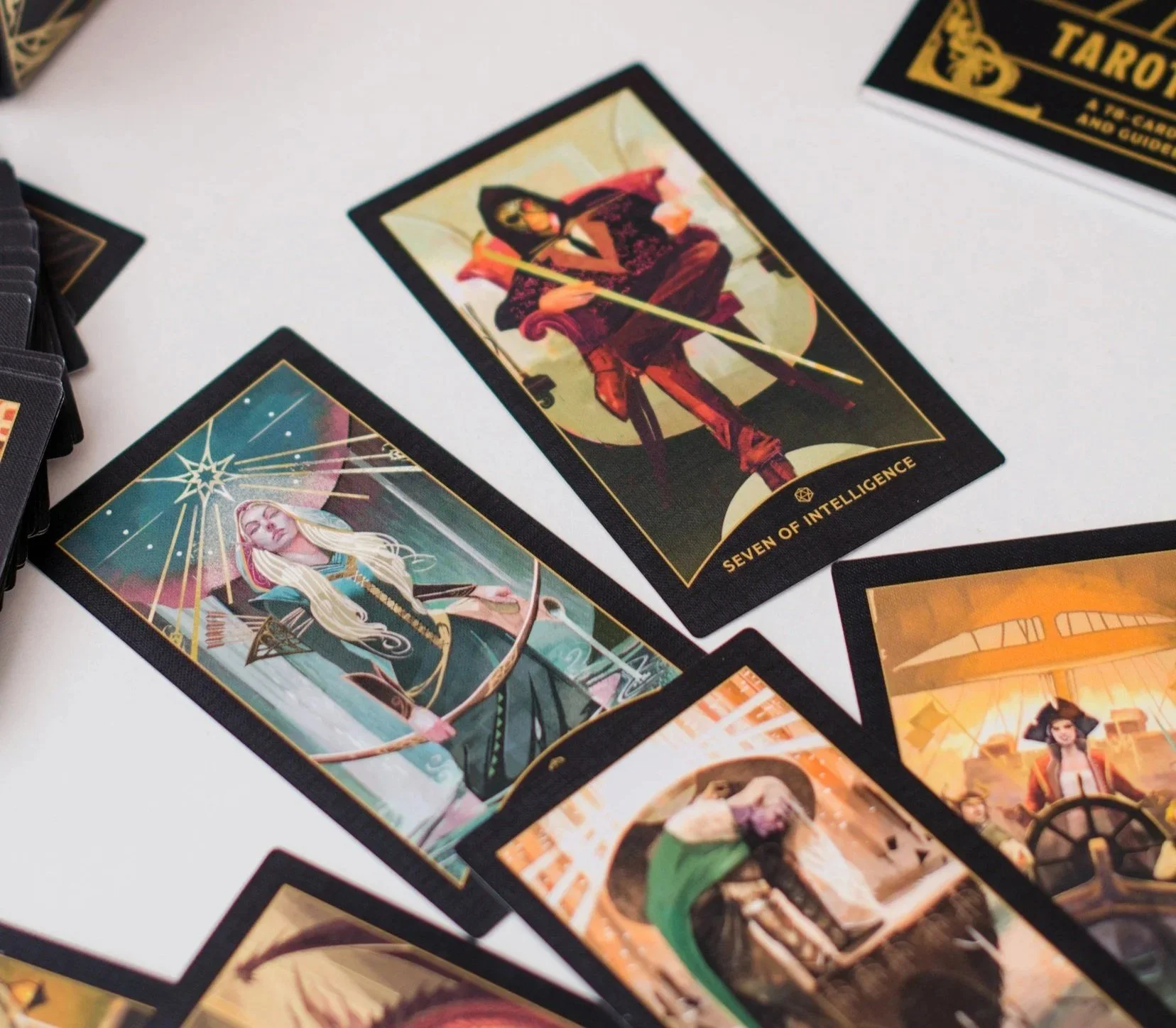
The Dungeons and Dragon Tarot Deck
So, no, what I’m about to share with you isn’t new. But it’s something I do for myself—quite often, actually—to help prompt me into writing adventures. I’ve used tarot to help me construct characters, design quests, and even to make the enormity of world-building just a little less massive of a feat. It helps me journal, to think, and it also helps me in therapy.
I’ve spent entire therapy sessions going over my tarot RPG journaling exercises, working through the scenarios, and examining my choices and reactions. If it helped me, I thought maybe it might help someone else.
So, if you’re here to learn how to use a tarot RPG journal—for fun or otherwise—I want to help.
Here we go.
How to Use Tarot for RPG Journaling
I use a simple three-card spread to build my narrative prompts. For me, it’s about blending fantasy storytelling with real-world reflection—using a character to explore my own patterns and choices.
My Tools
Here’s everything I use:
My tarot deck. (If I don’t have one on hand, but I want to write, I’ll just use an online generator).
A guide. I’ve been doing this a long time, but I still like having card descriptions handy to spark new ideas. Sometimes I find that a card pull might not have an immediate meaning or narrative hook that comes to mind. In that case, having the guide and looking up the basic themes associated with the cards can trigger something.
My writing medium. Sometimes it’s a computer, sometimes it’s that “special occasion” notebook I finally decided to use, and sometimes—if the spark hits me at the wrong time—it’s just a pen and the back of a CVS receipt.
My Three-Card Spread
I pull three cards to determine the arc of my entry:
Card 1: The Character. This is the “me” of the story, the player character on paper.
Card 2: The Quest. This is the call to action—the mission or the person pulling me to adventure.
Card 3: The World. This helps inform the environment my character exists in. It help me flesh out the environment and the “rules” I have to play by.
How I Build the Prompt
Once the cards are on the table, I start building. I look at the first card and really study the art. I ask myself what the artist was trying to portray and how it makes me feel. If the card doesn't have a human form on it, I’ll sometimes do a quick sketch of what a character embodying that card would look like.
Then, I use the second card to find the "friction." I try to find a quest that creates tension with my character’s nature. I ask: What am I being asked to do? Who is asking?
I try to find a genuine dilemma where there's no easy answer. That’s where the real work happens.
Finally, I let the third card tell me what kind of world I’m standing in. I use that as a frame for my character and their purpose in the adventure.
This isn't a perfect formula. Depending on the deck you're using, the cards you pull may not fit perfecting in these slots. Your first card should always inform your character, but from there, you can use the other cards to help fill in any gaps missing. For example, you may pull a card for the Quest that really doesn't give much of a “problem” to solve. Instead, you may treat that card as more of a “quest giver” type of character, and use the World you pulled to help create the friction you need between your characters.
If you feel like something is missing or needs to be fleshed out more, use your imagination! These cards are a guide to get a basic prompt idea, not hard and set rules.
The Writing Process
When I sit down to actually write, I try to stay in “narrative mode” while letting my own insights surface. I describe my character’s flaws, their reaction to the quest, and—most importantly—why they make the choices they do.
I’ve found that the magic happens when the story creates just enough distance for me to be honest with myself, but enough resonance that the insights feel true. I’m looking for the patterns: When have I been like this character in my real life? When has this approach served me, and when has it held me back?
Your Turn
To showcase this prompt-generation methodology and get started on your solo RPG journaling adventure, check out our pre-generated journal prompts in the Tabletop BLT Adventure Store!
Forge your own path in this standalone journaling RPG. The Sword or the Word is a digital tabletop exercise that combines high-fantasy storytelling with real-world reflection. Designed for players who enjoy character-driven narratives, this guide uses the symbolism of the tarot to explore the weight of our decisions.
The Story: As the embodiment of the Ace of Swords, you are known for your tactical mind and your great sword, Clarity. But when you are called to counsel a grieving Warrior Queen in a kingdom built on harmony (The Lovers), your sharpest edge may not be the right tool for the job.
What’s Inside:
A Guided Narrative: Follow a structured format to describe your character’s strengths, flaws, and ultimate choices.
Tarot Integration: Features a pre-made three-card spread to generate your character, quest, and setting.
Introspective Reflection: Post-game questions challenge you to examine how your character's choices mirror your real-life patterns of growth.
Flexible Journaling: Suitable for both long-form creative writing and quick bullet journaling.
Discover The Weight of Warmth, an immersive solo journaling RPG adventure that uses a three-card tarot spread to spark a personalized narrative for introspective writing. This tabletop exercise blends fantasy storytelling with real-world reflection, helping you explore your own patterns of growth through a fictional lens.
As the world succumbs to the "Great Cold" and the stars fade, you take on the role of The Magician—a powerful, centuries-old being entrenched in magic. Your quest, guided by the Justice card, places the fate of the universe in your hands as you decide whether to sacrifice a rare, trusting creature called an Ember to reignite the dying sun.
This Digital Download Includes:
Pre-Generated Narrative: A complete adventure with the tarot cards already pulled for you.
Character Development Prompts: Deeply explore your strengths, flaws, and motivations.
High-Stakes Moral Choices: Face a monumental decision: save the light or save the Ember.
Post-Game Reflection: Guided therapeutic exercises to mirror your choices against your real-life internal landscape.
Perfect for fans of tabletop RPGs, creative writing, and mindfulness tools, this guide provides a unique space for belonging and learning. Grab your favorite journal and prepare to face the edge of reality.

Discover The Gravity of Empathy, an immersive solo journaling RPG adventure that uses a three-card tarot spread to spark a personalized narrative for introspective writing. This tabletop exercise blends mechanical fantasy storytelling with deep emotional reflection, helping you explore the delicate balance between duty and mercy through a fictional lens.
In a world governed by the relentless turning of the Great Gear, you take on the role of a Cleric of Temperance—a soul dedicated to harmony and the "middle-path." Your setting, the Temple of the Changebringer (Wheel of Fortune), is a place of perpetual motion where fate is never static. Your quest begins when a destitute child (Five of Pentacles Reversed) seeks sanctuary, only to be crushed by a cursed relic they attempted to steal in a moment of desperation.
This Digital Download Includes:
Pre-Generated Narrative: A complete adventure with the tarot cards already pulled for you, establishing your character, the setting, and the stakes.
Archetypal Prompts: Explore the philosophy of balance and how it feels to have your grounded nature suddenly derailed.
The Weight of Choice: Face a complex three-way decision: take the curse upon yourself, nullify the relic’s magic and risk the temple’s collapse, or stand back and let fate take its course.
Post-Game Reflection: Guided therapeutic exercises designed to mirror your in-game choices against your real-world tendencies toward responsibility, detachment, and empathy.
Perfect for fans of solo RPGs, creative writing, and mindfulness tools, this guide offers a sanctuary for self-discovery. Open your journal and decide what you are willing to carry.